Thyroid Cancer Second Opinion: What Endocrine Oncologists Check
A second opinion from an endocrine oncologist before thyroid cancer treatment can catch misclassified biopsies, flag missing molecular tests, and confirm whether the planned surgery scope is right for your case. Here is exactly what a specialist reviews.
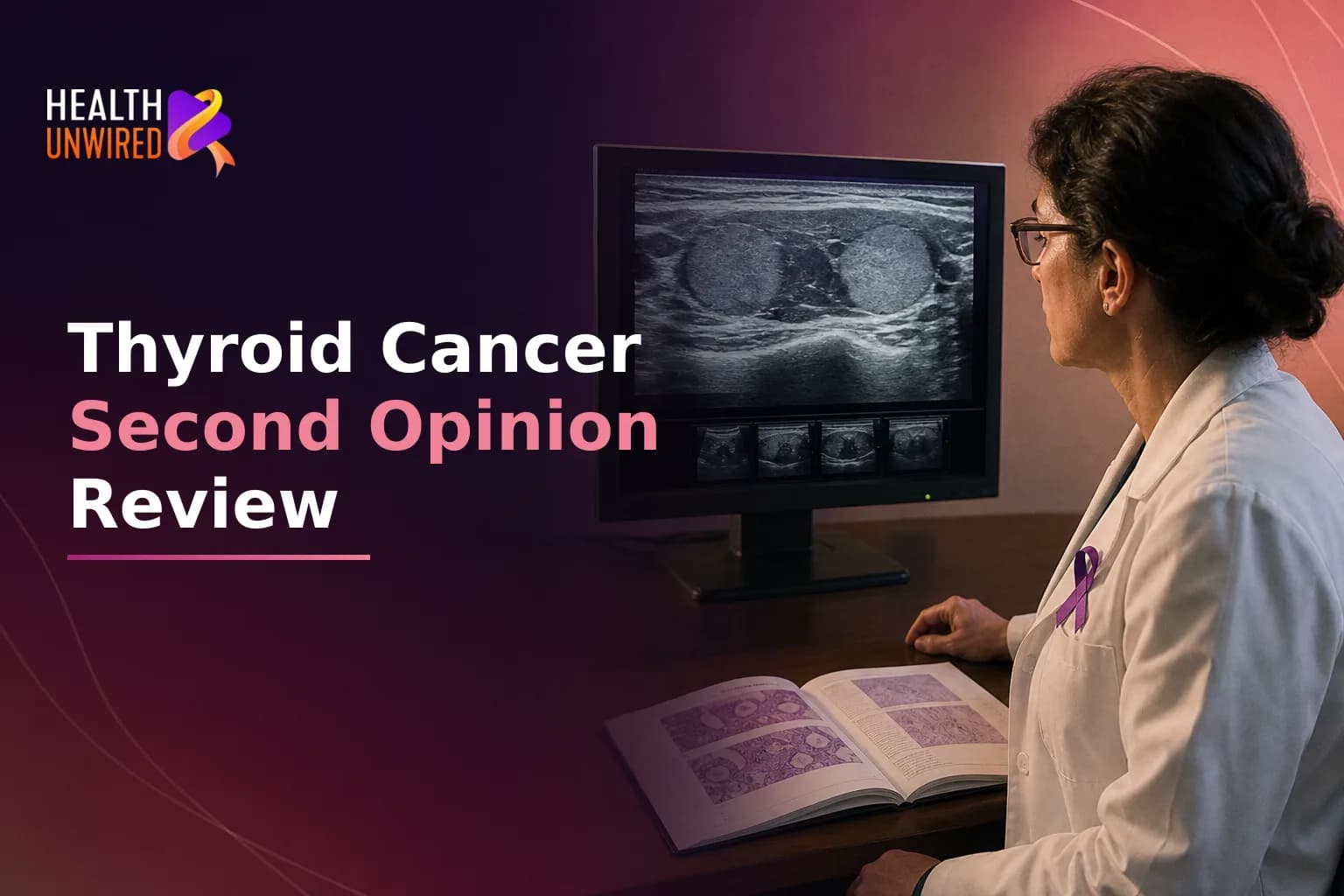
Updated on Aug 27, 2026
The most important step before your treatment starts
If you have just been diagnosed with thyroid cancer and already have a treatment plan, that is a good starting point. But before you commit to surgery, radioactive iodine, or active monitoring, take one step first: a second opinion from an endocrine oncologist.
This is not about doubting your current doctor. A second opinion is a normal step. The American Cancer Society encourages patients to seek one to confirm a diagnosis and understand all available treatment paths. Most oncologists expect it, and the conversation rarely damages the doctor-patient relationship.
The reason a second opinion matters in thyroid cancer is simple: thyroid cancer is not one disease. It is several different types, and each responds to treatment very differently.
Why thyroid cancer second opinions matter
Papillary thyroid cancer is the most common type and tends to grow slowly. Follicular thyroid cancer behaves similarly. Medullary and anaplastic thyroid cancers are rarer and more aggressive. The American Cancer Society explains how treatment decisions depend heavily on cancer type and stage - differences between types can change the treatment plan entirely.
There is more to consider. Biopsy results described as indeterminate - meaning the lab cannot tell from the sample alone whether the cells are cancerous - are common in thyroid cancer workups. A peer-reviewed study found that expert reviews disagreed with initial readings 28.6% of the time. In almost one-third of those cases, the disagreement changed how doctors managed the patient. Read the full peer-reviewed study on second opinions in thyroid cytology.
This variability is why specialist review before a major treatment decision makes sense. If you want to understand what typically changes across oncology when a second opinion is sought, this article on what changes after a second opinion in cancer care explains what typically happens.
What is an endocrine oncologist - and why does their review matter?
An endocrine oncologist is a cancer specialist who focuses on tumors of hormone-producing glands - the thyroid, parathyroid, adrenal glands, and related structures. They typically work as part of a team alongside head and neck surgeons, nuclear medicine specialists, and pathologists with experience in thyroid tissue.
A general oncologist can treat thyroid cancer. But an endocrine oncologist has specific knowledge of thyroid molecular markers, surgery decisions, radioactive iodine protocols, and risk classification systems. When your case falls into a gray zone - an indeterminate biopsy, a borderline staging call, or a question about whether the planned surgery is more extensive than needed - that expertise matters.
What an endocrine oncologist reviews in a thyroid cancer second opinion
Here is a plain-English walkthrough of what a specialist examines before offering their view on your treatment plan.
Your pathology report and biopsy slides
The review almost always starts with the tissue. A specialist pathologist will examine the actual fine-needle aspiration (FNA) slides or surgical biopsy material, not just the written summary. The goal is to confirm cancer type - papillary, follicular, Hurthle cell, medullary, or anaplastic. The National Cancer Institute's treatment guidelines for thyroid cancer explain how each subtype is staged and treated differently. A subtle misclassification at this stage can affect every decision downstream.
Molecular and genetic markers
Thyroid cancers may carry specific gene mutations. BRAF V600E, RAS mutations, and TERT promoter mutations are among the most clinically significant. These markers may help predict how aggressive the cancer is and whether targeted therapies could be considered if standard treatment proves insufficient later. A second opinion review will check whether molecular testing has been performed - and if not, whether ordering it now would change your treatment plan.
Molecular testing is an area where many patients find their initial workup was incomplete. For more information, see whether you need a second opinion on your molecular testing results.
Imaging - ultrasound, CT, and nuclear scans
An ultrasound of the neck is typically the first imaging step. CT or MRI may follow if the tumor is large or if the surgeon needs to assess nearby structures before operating. An endocrine oncologist will review these images carefully - especially to check for spread to nearby lymph nodes, which directly affects staging and the scope of any surgery required.
For patients with differentiated thyroid cancers (papillary or follicular types), a nuclear medicine scan using radioactive iodine may also be part of the review. This helps assess whether the cancer is likely to respond to radioactive iodine treatment after surgery.
Staging - and whether your classification is accurate
Thyroid cancer staging uses the American Joint Committee on Cancer (AJCC) TNM system: Tumor size, lymph Nodes involved, and Metastasis. Uniquely in thyroid cancer, the patient's age at diagnosis also factors into the final stage for differentiated types. A specialist will verify that your staging is correct. A staging error - even a small one - can lead to more aggressive treatment than your case warrants, or to under-treatment of a case that needs more.
Surgery scope - total thyroidectomy versus lobectomy
One of the most important surgical decisions in thyroid cancer is how much of the gland to remove. A total thyroidectomy removes the entire thyroid. A lobectomy (hemithyroidectomy) removes only the affected half. For smaller, lower-risk tumors, a lobectomy may deliver equivalent cancer control while preserving some natural thyroid hormone production - an important quality-of-life consideration. For higher-risk cases, total thyroidectomy remains the appropriate standard. The specialist will assess which approach fits your tumor characteristics, your age, and your risk profile.
Active surveillance - is immediate surgery truly needed?
For very small papillary thyroid cancers that have not spread - typically microcarcinomas measuring 1 cm or less - monitoring without immediate surgery is a recognized management option in current clinical guidelines. A review of current practice guidelines supports active surveillance for selected low-risk papillary thyroid microcarcinomas, with research suggesting the large majority of monitored tumors remain stable over time. An endocrine oncologist can tell you whether you are a candidate for this approach, and what a monitoring schedule would involve.
Radioactive iodine - whether you need it and at what dose
After surgery for differentiated thyroid cancer, some patients receive radioactive iodine (RAI) to destroy remaining thyroid tissue and lower the chance of recurrence. Not all patients benefit equally, and overuse of RAI has been recognized as a concern by oncology guideline bodies. A specialist review will assess whether RAI is appropriate for your risk level, at what dose, and what the evidence supports for a case like yours specifically.
TSH suppression after surgery
Most patients who have had a thyroidectomy take daily thyroid hormone replacement. The dose is sometimes adjusted to keep TSH (thyroid-stimulating hormone) levels lower than the normal range - a strategy called TSH suppression - to lower recurrence risk. The level of suppression appropriate for you depends on your risk category. A specialist will check whether the TSH target in your current plan reflects your actual risk level and whether the long-term tradeoffs have been explained clearly to you.
When should you seek a thyroid cancer second opinion?
Consider a second opinion in any of these situations:
- Your biopsy result was indeterminate or suspicious, and surgery has been recommended without further molecular testing.
- You have been told you need a total thyroidectomy and want to understand whether a lobectomy might offer equal protection.
- Your tumor is very small and you want to know whether active surveillance is a realistic option in your case.
- You have been diagnosed with medullary or anaplastic thyroid cancer - both call for prompt specialist team involvement.
- Molecular testing has not been done on your biopsy sample, and you want to know whether it would affect your plan.
- Your care team does not include an endocrine oncologist or a head and neck cancer specialist.
The same framework applies across cancer types. For a useful parallel, read about breast cancer second opinion reviews - the pathology-first approach is strikingly similar. The full breakdown is in the HealthUnwired guide on what oncologists review in a breast cancer second opinion.
How to get a thyroid cancer second opinion without traveling
You do not need to fly to a major cancer center to get a specialist's view. Remote second opinions - where you upload your pathology reports, imaging files, and current treatment recommendation, then speak with an endocrine oncologist by video - are practical and widely available. Dana-Farber Cancer Institute describes how a coordinated specialist approach to thyroid cancer review works, and quality remote second opinions follow this same model.
The wait between a thyroid cancer diagnosis and a confirmed second opinion often brings anxiety. Sleep disruption is common during this period. While you are organizing your reports and waiting for your consultation, some patients find it useful to address that stress directly. For over-the-counter support, see the Sleep and Stress options at Ayurnomics, which include formulations designed for the kind of disrupted sleep a cancer diagnosis can bring.
You can upload your pathology reports and imaging, choose an endocrine oncologist, and join a video consultation within 48 hours from anywhere in the world. Book a thyroid cancer second opinion and have a specialist review your full case before your treatment begins.
When to talk to your doctor
Reach out to your oncologist or care team right away if your biopsy result is unclear, if you feel rushed toward a surgery date before fully understanding your options, or if your diagnosis is medullary or anaplastic thyroid cancer - both require prompt specialist review. A second opinion does not delay treatment in most thyroid cancer cases. It helps you make the decision with confidence.
This article is for general information and is not a substitute for medical advice. Always consult your oncologist or care team about your specific situation.
Similar Topics

Leukemia Second Opinion: What Hematologic Oncologists Review
A leukemia second opinion is a recognized and normal step in blood cancer care. This guide explains exactly w…
HealthUnwired Team
Sep 18, 2026
Understanding Your Lymphoma Diagnosis and Staging
A lymphoma diagnosis involves three steps: a biopsy, a pathology report naming your exact subtype, and a stag…
HealthUnwired Team
Sep 16, 2026
Newly Diagnosed with Leukemia: Your First Steps
A leukemia diagnosis is overwhelming, but your first moves can shape everything that follows. Here is what to…
HealthUnwired Team
Sep 14, 2026