Breast Cancer Treatment Options: Which Path Fits Your Diagnosis?
Surgery, radiation, hormone therapy, targeted therapy - breast cancer treatment is built around your specific tumor type and stage. This guide breaks down the main paths and helps you know what to ask.
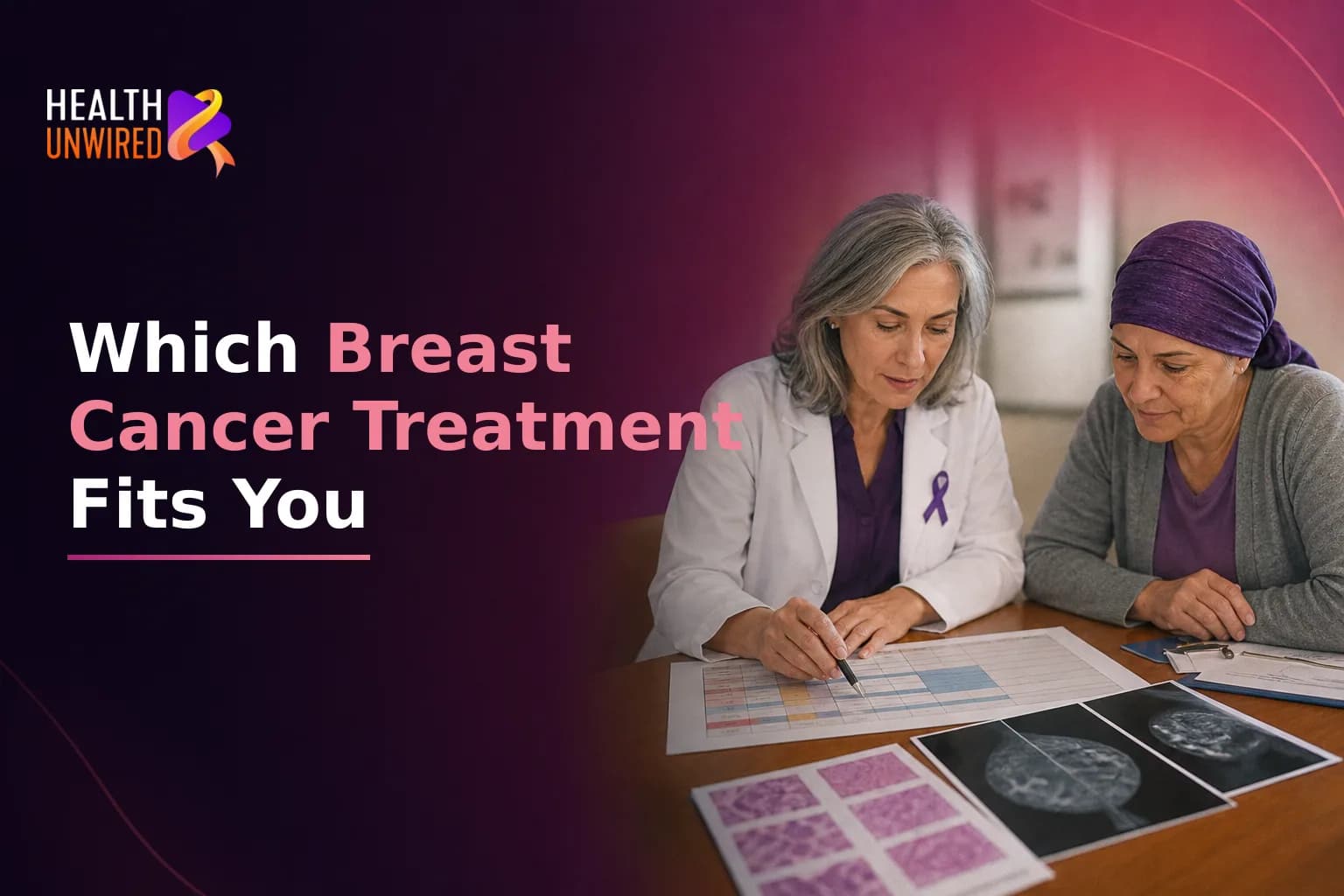
Updated on Sep 14, 2026
Breast Cancer Treatment Options: Which Path Fits Your Diagnosis?
Finding out you have breast cancer often brings many decisions before your first appointment with a specialist. Surgery or no surgery - and if surgery, which kind. Radiation, chemotherapy, hormone therapy, targeted drugs. The list can feel overwhelming before you have time to process the diagnosis.
This guide will not choose for you. But it will help you understand the main treatment paths, how they differ, and what questions to bring to your care team. Your plan will be shaped by two key pieces of information: the stage of your cancer and its molecular subtype. Get those two things clear, and the rest of the conversation becomes easier to follow.
What Your Pathology Report Tells Your Team
Before your team can plan treatment, your tumor tissue is tested in a lab. This testing identifies which biological signals are driving the cancer's growth - a process that typically takes several days after a biopsy.
According to the American Cancer Society, there are four main breast cancer subtypes based on tumor markers:
- Hormone receptor-positive (HR+): the cancer is fueled by estrogen, progesterone, or both. This is the most common subtype.
- HER2-positive: the cancer overproduces a protein called HER2, which signals cells to grow and divide quickly.
- HR-positive and HER2-positive: both drivers are present in the same tumor.
- Triple-negative: the tumor is not driven by hormones or HER2. This subtype is less common and responds to different treatments.
Your subtype determines which systemic treatments - medicines that travel through your bloodstream to reach cancer cells anywhere in the body - will work for you. Stage tells your team how large the tumor is and whether it has spread to lymph nodes or other organs. Both pieces of information drive every treatment decision that follows.
Some patients with hormone receptor-positive, HER2-negative early-stage disease may also get a genomic test - such as Oncotype DX - that looks at specific genes in the tumor tissue to estimate the risk of recurrence. These tests help some patients and their doctors decide whether chemotherapy adds enough benefit along with hormone therapy alone. Asking whether a genomic test applies to your case is a good question to ask at your first detailed conversation with your oncologist.
Lumpectomy vs. Mastectomy - The First Surgical Choice
For most people with localized breast cancer, surgery is part of the plan. The two main options are a lumpectomy and a mastectomy, and the choice between them is one of the most common decisions patients face early in treatment.
A lumpectomy (also called breast-conserving surgery) removes the tumor and a small rim of healthy tissue around it. The rest of the breast stays intact. A mastectomy removes the entire breast. In some cases, both breasts are removed - this is called a bilateral mastectomy. It is most often considered when a person carries a BRCA1 or BRCA2 gene change that raises the risk of cancer in the other breast, or when tumors are found in multiple areas of the same breast.
A 25-year follow-up of a National Cancer Institute randomized trial found that overall survival was similar between breast-conserving therapy and mastectomy for women with early-stage breast cancer. The evidence shows that lumpectomy works as well as mastectomy for patients who are good candidates. However, lumpectomy almost always requires radiation afterward - an important factor if you live far from a radiation center or have limited time for a multi-week treatment course.
How Do Lumpectomy and Mastectomy Compare?
| Factor | Lumpectomy (Breast-Conserving Surgery) | Single Mastectomy |
|---|---|---|
| Tissue removed | Tumor plus a small margin of healthy tissue around it | The entire breast |
| Best suited for | Stage I-II tumors; smaller tumor relative to breast size; single tumor site | Larger tumors, multiple tumor sites in one breast, or known high-risk BRCA gene change |
| Radiation after surgery | Usually required for most patients | Usually not required; may be added for high-risk features such as affected lymph nodes |
| Surgical complications | Lower rate compared to mastectomy | Higher rate of complications than lumpectomy, per NCI |
| Long-term survival (early-stage) | Similar to mastectomy for eligible patients | Similar to lumpectomy for eligible patients |
| Reconstruction option | Not applicable - breast tissue is preserved | Available at the time of surgery or as a later procedure |
Sources: 25-year results of the NCI randomized breast conservation trial; NCI report on quality of life after breast cancer surgery, 2021.
For many patients with early-stage disease, the evidence shows similar survival with either surgical approach. The decision often comes down to personal values, body image, access to a radiation center for follow-up, and long-term comfort with recurrence risk. If minimally invasive approaches - such as nipple-sparing or robotic surgery - matter to you, the specialist resource on robotic breast cancer surgery at BreastCancer.One offers a plain-English overview of what those techniques involve and which patients tend to be good candidates.
When Radiation Is Part of Your Plan
Radiation therapy uses targeted beams of energy to destroy any cancer cells that might remain in the breast or nearby tissue after surgery. It works with surgery to lower the chance of the cancer returning in the breast area.
After a lumpectomy, doctors almost always recommend radiation. The American Cancer Society describes whole-breast radiation as the standard approach, typically taking several weeks. Some women with early-stage, lower-risk tumors may be candidates for accelerated partial-breast irradiation (APBI) - a shorter course that delivers higher doses to the area where the tumor was removed, often over five days to two weeks. Eligibility for APBI depends on tumor size, node status, and age, so ask your radiation oncologist whether it applies to you.
After a mastectomy, radiation is less common. Your team may recommend it if the original tumor was large, if many lymph nodes were involved, or if the tissue margins were not fully clear after surgery.
Does Treatment Come Before or After Surgery?
Treatment given before surgery is called neoadjuvant therapy. Treatment given after is adjuvant therapy. The order matters for your overall plan, and your team will recommend one approach - or a combination of both - based on your subtype, stage, and tumor size.
Doctors may use neoadjuvant chemotherapy or targeted therapy to shrink a larger tumor before surgery. After neoadjuvant treatment, a smaller tumor might make lumpectomy possible for someone who would otherwise need a mastectomy. For triple-negative breast cancer, doctors often combine chemotherapy and immunotherapy before surgery for many patients with locally advanced disease, as this may lead to a pathologic complete response - meaning no living cancer cells are found when the removed tissue is examined in the lab.
Adjuvant therapy, given after surgery, aims to reduce the risk of the cancer returning. Some patients receive systemic therapy at both stages - before surgery to shrink the tumor and after to address any remaining risk.
Systemic Therapy - Matching Your Subtype
Systemic therapies reach cancer cells throughout the body via the bloodstream. The type you receive - and whether you need any at all - depends directly on your tumor's subtype.
HR+ Tumors: Hormone Therapy
If your tumor is hormone receptor-positive, hormone therapy (also called endocrine therapy) works by blocking the cancer from using estrogen or progesterone to grow. Tamoxifen and aromatase inhibitors are the most commonly used medications for this subtype. Treatment typically continues for five to ten years, depending on your assessed risk of recurrence and menopausal status.
Hormone therapy can cause menopause-like effects, including hot flashes, joint aches, and changes in bone density. Always discuss any supplement or over-the-counter product with your oncologist before starting, as some may interact with your treatment.
HER2+ Tumors: Targeted Therapy
If your tumor overproduces HER2 protein, doctors usually combine targeted therapy with chemotherapy to block that growth signal. Research shows that trastuzumab combined with chemotherapy reduces the risk of recurrence by approximately 50% in early-stage HER2-positive disease and improves overall survival. Newer HER2-targeted medications are now available, particularly for advanced disease - ask your oncologist about the options approved for your specific stage and situation.
Triple-Negative Tumors: Chemotherapy and Immunotherapy
Triple-negative breast cancer does not respond to hormone therapy or HER2-targeted drugs, so chemotherapy is the main systemic treatment. For some patients whose tumors contain a protein called PD-L1, doctors may add immunotherapy before or after surgery. If you carry a BRCA1 or BRCA2 gene change, certain targeted medications may also be an option in some clinical settings. Ask your oncologist about clinical trial eligibility.
Should You Get a Second Opinion Before You Choose?
A second opinion is normal and helpful. It does not mean you distrust your current doctor. Treatment recommendations for breast cancer can differ meaningfully between centers. Common areas where plans vary include the choice between lumpectomy and mastectomy, the decision to use a genomic test such as Oncotype DX to determine whether chemotherapy is needed, and whether neoadjuvant therapy is appropriate for your tumor.
Read the full guide on what oncologists review in a breast cancer second opinion to understand what a reviewing specialist will look at in your case. If you are under 40 and have fertility-related questions with your treatment decisions, the article on breast cancer under 40 and the second opinion addresses those concerns in detail.
You can upload your pathology reports and imaging, choose a verified oncologist, and have a video consultation within 48 hours through HealthUnwired's online consultation service - no travel required.
Questions to Bring to Your Appointment
You do not need to have all the answers before you walk in the door. Having the right questions helps you use the appointment well and leave with a clearer plan.
- What is my tumor's hormone receptor status and HER2 status, and what do they mean for my options?
- Am I a candidate for breast-conserving surgery, and if not, why not?
- Should I have a genomic test to help decide whether chemotherapy is needed?
- Would treatment before surgery be better for shrinking my tumor first?
- How long will my full treatment plan likely last?
- Is there a clinical trial I should consider before I start?
Bring a trusted person with you if you can. Someone else there can help you remember what the doctor says and take notes during an appointment where a lot of information is shared in a short time.
When to Talk to Your Doctor
If you have just received a breast cancer diagnosis, speak with your oncologist or breast surgeon before making any treatment decisions. If your current plan feels unclear, ask to be seen by a multidisciplinary team - a group that typically includes a surgeon, a medical oncologist, a radiation oncologist, and a pathologist who review your case together. If you are not sure all options have been considered, requesting a second opinion is a normal step that most oncologists will understand.
This article is for general information and is not a substitute for medical advice. Always consult your oncologist or care team about your specific situation.
Read the full guide
Similar Topics
Leukemia Second Opinion: What Hematologic Oncologists Review
A leukemia second opinion is a recognized and normal step in blood cancer care. This guide explains exactly w…
HealthUnwired Team
Sep 18, 2026
Understanding Your Lymphoma Diagnosis and Staging
A lymphoma diagnosis involves three steps: a biopsy, a pathology report naming your exact subtype, and a stag…
HealthUnwired Team
Sep 16, 2026
Newly Diagnosed with Leukemia: Your First Steps
A leukemia diagnosis is overwhelming, but your first moves can shape everything that follows. Here is what to…
HealthUnwired Team
Sep 14, 2026