Breast Cancer Under 40: Fertility and the Second Opinion
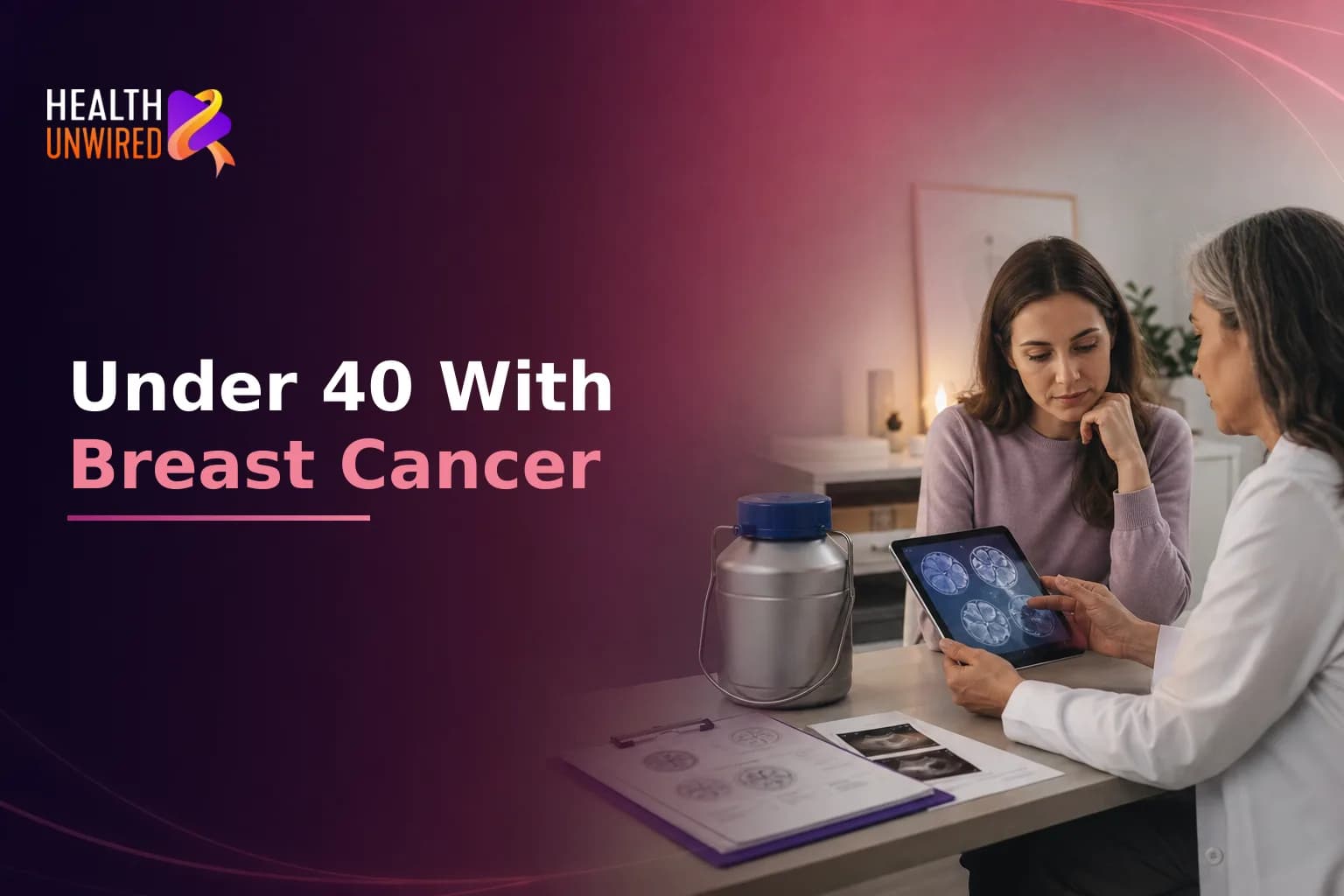
If you are under 40 and newly diagnosed with breast cancer, two decisions cannot wait: protecting your fertility and getting a second opinion on your treatment plan. Here is what to act on first.
Updated on Sep 7, 2026
If you have been diagnosed with breast cancer before age 40, you are facing a set of decisions that most breast cancer patients never encounter at diagnosis. Two of them cannot wait: whether to protect your fertility before treatment begins, and whether to get a second opinion on your pathology and your proposed plan. Both windows can close faster than you expect. This guide walks you through both.
Why Breast Cancer Before 40 Is Different
Breast cancer is not one disease. It is a family of diseases, and the version that tends to appear in younger women often behaves differently than the version diagnosed at 60 or 70.
Tumors in women under 40 are more likely to be high-grade, more likely to have spread to nearby lymph nodes, and more likely to be hormone-receptor negative at diagnosis - all of which shape the treatment decisions ahead. Studies comparing younger and older breast cancer patients consistently find these differences in tumor biology.
There is also a screening gap. Most mammography programs around the world start at age 40, 45, or 50. Women in their 20s and 30s are rarely included in routine screening. That means a lump in a younger woman is often found by the patient herself - and by the time it is found, it may have been growing longer than a routine program would have caught it.
None of this means your situation is without hope. Many young women with breast cancer complete treatment and go on to full lives, including pregnancies. But the different biology does mean that your diagnosis deserves careful, expert review before treatment begins. A second opinion is a normal part of that process - not a lack of confidence in your current doctor.
Understanding Your Tumor Type - The Foundation of Every Decision
The most important piece of information in your pathology report is your receptor status. This tells you what the tumor is feeding on and what drugs can target it. Your oncologist should explain three things:
- Hormone receptor status (ER and PR): Estrogen receptor-positive (ER+) or progesterone receptor-positive (PR+) tumors respond to hormonal therapies. These therapies block estrogen - which can affect your fertility and trigger menopause-like symptoms. Many patients with hormone-positive cancer are advised to take hormonal therapy for 5 to 10 years after initial treatment ends.
- HER2 status: HER2-positive tumors have high levels of a protein that drives tumor growth. Targeted therapies exist for this subtype and are often very effective. Some of these agents may affect heart function over the long term, which matters for a patient who may have 40 or 50 years of life ahead.
- Triple-negative status: According to the American Cancer Society, triple-negative breast cancer accounts for roughly 10 to 15 percent of all breast cancers and tends to be more common in younger women. It does not respond to hormonal therapy or HER2-targeted drugs. Treatment usually relies on chemotherapy, which carries its own risks to fertility and ovarian function.
Your subtype is not just a label. It determines whether surgery comes before or after chemotherapy, which drug families are on the table, and how long you will be in active treatment. If you are unsure what your pathology report says - or whether the subtype classification is correct - that is one of the clearest reasons to seek a specialist second opinion. To see exactly what a reviewing oncologist examines, read our guide to what oncologists review in a breast cancer second opinion.
The subtype also influences your surgical decision - whether breast-conserving surgery is realistic or whether a mastectomy is recommended. For a plain-English look at minimally invasive techniques, nipple-sparing options, and robotic surgical approaches, the specialist resource on robotic breast cancer surgery at BreastCancer.One is a useful starting point when preparing questions for your surgical team.
Fertility Preservation: The Window That Closes First
Chemotherapy can damage your ovaries. Hormonal therapy suppresses estrogen for years. Both can affect your ability to get pregnant after treatment. That does not mean pregnancy is impossible - but it does mean that if you want children, you need to act before treatment starts.
The American Society of Clinical Oncology (ASCO) recommends that oncologists refer patients who wish to preserve fertility to a reproductive specialist as early as possible - ideally before any chemotherapy or hormonal treatment begins. Their updated clinical guidelines recognize several options:
- Embryo cryopreservation (freezing fertilized eggs): The most established method. You take hormone injections for about two weeks to stimulate your ovaries, eggs are retrieved and fertilized, and the embryos are frozen for later use. This is typically used by people with a partner or a chosen sperm donor.
- Egg (oocyte) cryopreservation: The same process, but eggs are frozen without fertilization. This is the right option if you do not have a partner or prefer not to create embryos. Mayo Clinic notes that eggs can survive the freezing and thawing process with a success rate of up to 85 percent.
- Ovarian tissue cryopreservation: A portion of the ovary is removed and frozen for later transplantation. This may suit patients who cannot delay treatment long enough for the full egg-retrieval process. It is still considered an emerging technique at most centers.
- GnRH agonist therapy: Injections given during chemotherapy to suppress ovarian activity and may reduce damage to the ovaries during treatment. This is not a substitute for egg or embryo freezing, but it may help preserve some ovarian function alongside other methods.
The two-to-three-week delay that egg or embryo retrieval requires is medically acceptable for many early-stage cancers. For some faster-growing tumors, your oncologist may want to start treatment sooner. This is a real tension, and it is one that a second opinion can help you think through - ideally with an oncologist who has specific experience treating young women with breast cancer.
Research reviewed by the National Cancer Institute suggests that fertility preservation procedures are generally safe for breast cancer patients and do not appear to worsen cancer outcomes. Data presented at the 2024 ASCO Annual Meeting found that among young patients who had preserved fertility and later attempted pregnancy, 73 percent became pregnant at least once. That is not a guarantee, but it is meaningful information for planning.
If you are hormone receptor-positive and begin aromatase inhibitors or ovarian suppression therapy, you may experience menopause-like symptoms: hot flashes, joint discomfort, mood changes, and disrupted sleep. Many younger women find these side effects harder to manage than expected. Talk to your oncologist about managing these symptoms and before adding any supplement during active treatment.
If you have also been reading about fertility decisions for other gynecological cancers, our related guide on fertility preservation decisions in ovarian cancer covers parallel questions and may offer useful context.
Why a Second Opinion Carries Extra Weight Under 40
For younger patients with breast cancer, the stakes around treatment choice are unusually high - for the next few years and for the next few decades. A therapy that carries a small long-term risk of heart damage, early bone loss, or premature menopause means something very different at 34 than it does at 64.
A specialist who reviews your case with fresh eyes may:
- Re-examine your pathology slides and confirm or revise the subtype classification
- Recommend genomic testing - such as Oncotype DX or MammaPrint - to help clarify whether chemotherapy will genuinely benefit your case
- Suggest a different sequence of treatments (chemotherapy before surgery rather than after, for example)
- Identify clinical trials you may be eligible for that your first team did not mention
A significant portion of cancer patients who seek a second opinion receive recommendations that differ from their original plan. For women under 40, where the intersection of treatment, fertility, and long-term health is unusually complex, that possibility is worth taking seriously. To understand how treatment plans can shift after a second look, see our article on what changes after a second opinion in cancer care.
Questions to Ask at Every Consultation
Whether it is your first appointment or your second opinion, bring these questions:
- What is my exact receptor status - ER, PR, and HER2 - and what does each one mean for my treatment options?
- Should I see a fertility specialist before treatment begins, and how much time do I realistically have?
- Is chemotherapy given before or after surgery in my case, and why?
- What are the long-term effects of the proposed treatment on my heart, bones, and hormonal health?
- Is breast-conserving surgery a realistic option for me, or is mastectomy recommended - and why?
- Would genomic testing help clarify whether chemotherapy is likely to benefit my case?
- Are there any clinical trials I should know about?
You will not get all the answers in one visit. But asking these questions early puts you in a much stronger position - whether you stay with your current oncologist or seek additional input before committing to a plan.
How to Get a Specialist Second Opinion Quickly
Getting a second opinion used to mean booking a flight to a major cancer center and waiting weeks for an appointment. Today, remote consultations with specialists are available and can move faster.
Many patients can now upload their pathology reports, imaging results, biopsy records, and surgical notes securely and join a video consultation with a breast cancer specialist within days from home. This option matters most for patients who are caring for young children and cannot easily travel, who live far from a specialist breast cancer center, or who need to move quickly because a treatment start date is already set but still want a second opinion first.
The sooner you seek an additional opinion, the more options remain open.
When to Talk to Your Doctor
If you are under 40 and newly diagnosed with breast cancer, raise fertility preservation in your very first oncology appointment - before a treatment plan is finalized. Ask for a full explanation of your receptor status and subtype, and ask whether a second opinion is possible within your treatment timeline. If your oncologist discourages a second opinion, that is itself useful information.
This article is for general information and is not a substitute for medical advice. Always consult your oncologist or care team about your specific situation.
Read the full guide
Similar Topics
Ovarian Cancer and Fertility: Should You Preserve Your Options?
A new ovarian cancer diagnosis and the wish to have children do not have to be in conflict. Here is what you …
HealthUnwired Team
Aug 23, 2026
Should I Preserve My Fertility Before Ovarian Cancer Treatment? What You N…
If you are diagnosed with ovarian cancer during your reproductive years, there may be steps you can take to p…
HealthUnwired Team
Jun 8, 2026
Leukemia Second Opinion: What Hematologic Oncologists Review
A leukemia second opinion is a recognized and normal step in blood cancer care. This guide explains exactly w…
HealthUnwired Team
Sep 18, 2026