Colorectal Cancer Treatment in India for UAE Patients
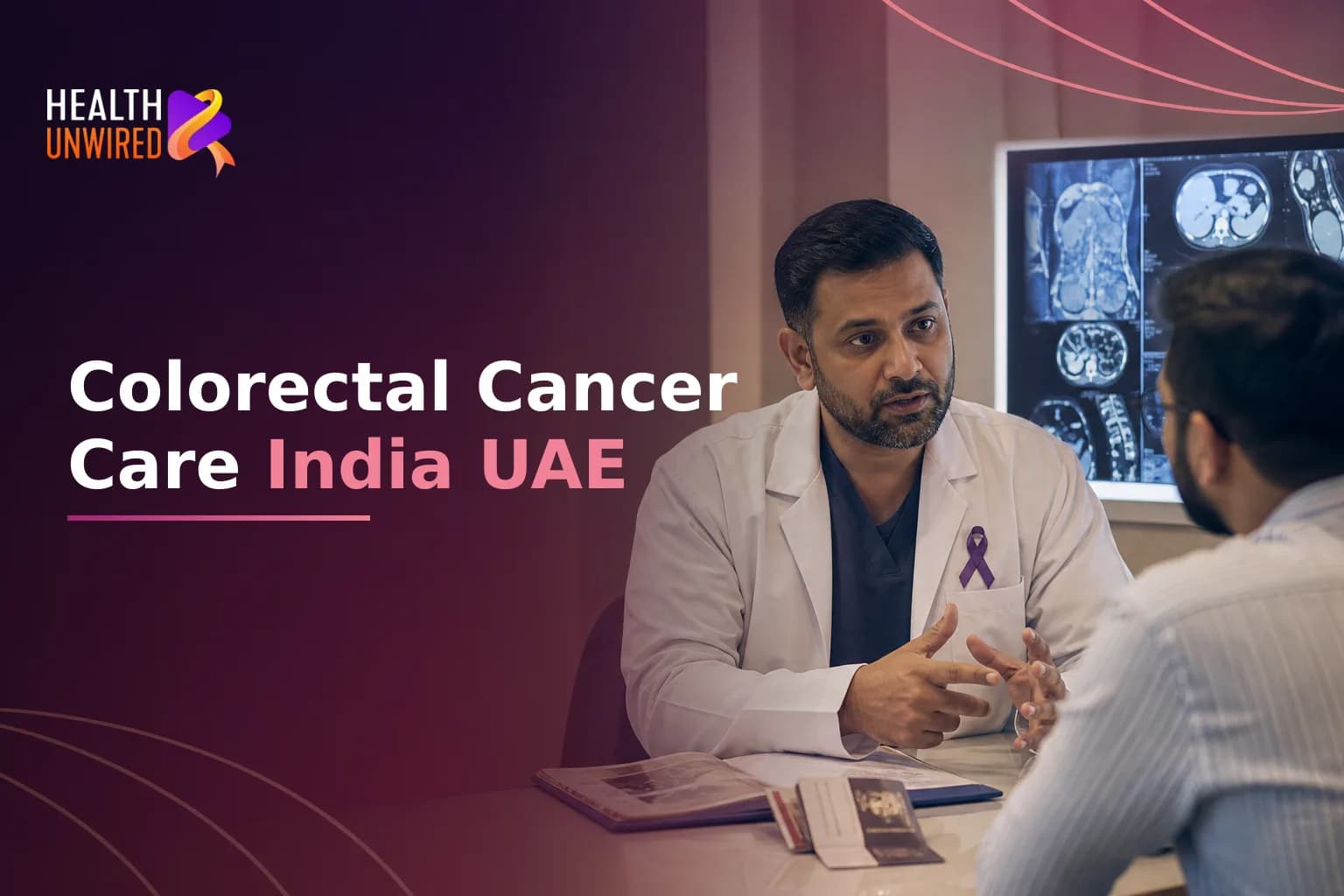
UAE patients with colorectal cancer increasingly travel to India for access to specialist oncology units and lower costs. This guide covers how costs compare, which centres to consider, the e-Medical Visa process, and how to manage follow-up care from home.
Updated on Aug 6, 2026
If you or someone you care for has been diagnosed with colorectal cancer and you live in the UAE, one question comes up quickly: is treatment at home the best option, or does traveling to India make sense? This guide answers that question plainly. It covers how costs compare, which specialist centres to research, the visa process, and what to expect when you return home.
The World Health Organization reports approximately 1.9 million new cases of colorectal cancer worldwide in 2022, making it one of the most commonly diagnosed cancers globally. In the UAE and the broader Gulf region, colorectal cancer consistently ranks among the top cancers recorded, and the WHO Eastern Mediterranean Regional Office identifies colorectal cancer as among the leading cancer types in the UAE. Demand for specialist care is growing, and some patients find that local options do not fully meet their needs for subspecialty depth or cost.
Why UAE patients consider India for colorectal cancer care
The reasons are mostly practical. Private oncology care in the UAE can be expensive, and waiting times for specialist colorectal surgery - particularly complex laparoscopic or robotic procedures - can stretch for weeks. India's major cancer hospitals are accredited by the Joint Commission International (JCI), staffed by surgeons trained in the UK, US, and Europe, and specifically set up to receive international patients. For UAE residents who want quality care and reliable logistics, the experience is manageable.
If you have already read about why GCC patients travel to India for cancer treatment, the pattern will feel familiar: shorter waiting times, lower overall costs, and dedicated international patient departments that handle translation and coordination.
How does colorectal cancer treatment compare: India vs UAE private hospitals?
| Factor | India (Specialist Private Hospital) | UAE (Private Oncology Centre) |
|---|---|---|
| Relative cost | Substantially lower than comparable UAE private care for most procedures; request itemised written quotes directly from hospital international departments | Among the highest in the GCC region for private oncology; may be partially covered by health insurance depending on your policy |
| Hospital accreditation | JCI and NABH (National Accreditation Board for Hospitals and Healthcare Providers, India's equivalent of JCI) widely available at major centres | JCI, Dubai Health Authority (DHA), and Abu Dhabi Health Services (SEHA) regulated |
| Medical visa required | Yes - India e-Medical Visa; up to 2 attendants allowed on e-Medical Attendant Visas; typically valid 6-12 months with multiple-entry option | Not applicable - treatment within UAE |
| Colorectal subspecialty depth | Dedicated colorectal surgical oncology units at Tata Memorial, Apollo, Fortis, and HCG centres; high annual case volumes | Varies by hospital; colorectal subspecialty depth can be limited outside the largest UAE centres |
| Typical total stay required | 4-6 weeks for surgery plus supervised recovery; shorter for a diagnostic review or chemotherapy planning visit only | Not applicable |
| Remote follow-up post-treatment | Available via telemedicine; major hospitals offer scheduled video follow-up for international patients after you return home | In-person follow-up available locally in the UAE |
Visa details sourced from BLS International's official India Medical Visa application centre for UAE applicants. Cost comparisons are indicative and reflect general patterns reported by hospitals serving international patients. Always request a written itemised quote directly from hospitals before making any decision.
India's major accredited cancer hospitals offer care that is broadly comparable in standard to UAE private oncology, at significantly lower cost for most procedures. The trade-off is travel time - typically 3 to 4 hours by air from Dubai to Mumbai or Delhi - and a stay of several weeks away from home. For many UAE patients, that trade-off is worth it.
What colorectal cancer treatment in India typically involves
Colorectal cancer treatment depends on the tumour's location, stage, and molecular profile. Your oncologist will recommend a combination of surgery, chemotherapy, radiation, or targeted therapy - and the right mix depends on your individual pathology results. Indian specialist centres offer all of these, including robotic-assisted surgery and molecular testing.
A typical treatment visit for a UAE patient might look like this:
- A diagnostic review on arrival (usually 2 to 3 days) to allow the Indian team to confirm their reading of your scans, biopsy slides, and staging before treatment begins
- Surgery, if surgery is part of your plan - approaches may include laparoscopic or robotic techniques, depending on tumour location and the team's recommendation
- An in-hospital recovery period, typically 4 to 7 days for uncomplicated cases
- A supervised outpatient recovery period before you are medically cleared to fly home
- Chemotherapy or radiation planning, which may begin in India or continue at home under the Indian team's written guidance
Robotic-assisted colorectal surgery uses smaller incisions and may speed recovery. It is available at several major Indian centres. Ask specifically about this option when you request your initial hospital assessment.
Which specialist centres in India treat colorectal cancer?
Several Indian hospitals have dedicated colorectal oncology programs and serve international patients well. Key centres to research:
- Tata Memorial Hospital (Mumbai) - India's most established dedicated cancer centre, with a long-running colorectal oncology unit and significant experience in complex and advanced cases.
- Apollo Cancer Centres (Chennai, Delhi, Hyderabad, and others) - JCI-accredited, with dedicated international patient divisions and colorectal surgical oncology capability across multiple cities.
- Fortis Memorial Research Institute (Gurugram, near Delhi) - Known for robotic-assisted colorectal surgery and close proximity to Indira Gandhi International Airport, making it practical for Dubai and Abu Dhabi travellers.
- HCG Cancer Centre (Bengaluru and multiple other cities) - India's largest specialised oncology network, with gastrointestinal oncology units at numerous locations across the country.
- Rajiv Gandhi Cancer Institute and Research Centre (Delhi) - A cancer-only facility with medical and surgical oncology teams experienced in colorectal cases, including complex pelvic resections.
Before committing to any centre, verify their accreditation independently and ask for a review of your specific case by a colorectal surgical oncologist - not a general oncologist. Ask how many colorectal cancer procedures they perform each year. Case volume matters for complex operations.
How to get your India e-Medical Visa from the UAE
UAE residents apply for an India e-Medical Visa through BLS International's India visa application centres in the UAE, which are the official India visa processing points for UAE applicants. The process is straightforward once you have your hospital documentation ready.
You will need to gather:
- A passport valid for at least 6 months with at least 2 blank pages
- A letter from the Indian hospital confirming they have reviewed your case and agreed to treat you
- A referral letter from your UAE-based specialist confirming the need for treatment in India
- Your complete medical reports, imaging discs, and pathology results
- Proof of financial means to cover your treatment and living costs during your stay
- Passport-size photographs meeting Indian visa specifications
The e-Medical Visa is typically valid for 6 to 12 months. Up to two attendants (family members or close associates) may travel with you on e-Medical Attendant Visas. Multiple-entry visas are available for further treatment or follow-up visits.
Start the visa application when you book your hospital consultation. Processing can take a week or more. For a full step-by-step walkthrough of the India medical tourism process from first contact to return home, the guide on medical tourism to India: visas, travel, and remote follow-up covers each stage in detail.
What to bring: preparing your medical records
Indian oncology teams review your case and form their own clinical opinion on arrival. Pack the following before you leave:
- All imaging: CT scans, MRI, PET-CT, colonoscopy reports, and any ultrasound results - digital copies and original discs where available
- Biopsy and pathology reports, including any molecular testing results such as MSI status or KRAS, NRAS, and BRAF mutation findings if these have been done
- A clear summary of any treatment received to date, including drug names, doses, and dates of administration
- Operative reports if you have already had surgery
- Recent blood results and any tumour marker measurements
If your reports are in Arabic, most major Indian hospitals' international patient departments offer translation on arrival. Imaging discs and lab results in English will speed up your initial review. Organise these documents when you book your flights.
Should you get a second opinion before traveling?
Before committing to a treatment plan in India or anywhere else, ask an independent colorectal oncologist for a second opinion. It may confirm the plan you already have. It may also identify molecular testing that has not yet been done, or suggest changes that matter to your approach. This is standard practice before a major treatment decision.
You do not need to travel for this. Through HealthUnwired, you can upload your reports, scans, and pathology results and receive a video consultation with a verified colorectal oncologist within 48 hours, from wherever you are in the UAE. To understand how the three main decision steps compare - your local oncologist, an online second opinion, and care abroad - see local oncologist vs online second opinion vs care abroad.
If your oncologist has given you a treatment plan and you want an independent review before making the trip to India, book a video consultation at HealthUnwired - upload your records, choose a verified colorectal oncologist, and receive a written report. Most consultations are completed within 48 hours, and no travel is required.
Managing follow-up care after you return to the UAE
You can still access your Indian care team from home. Most major Indian cancer hospitals offer telemedicine follow-up for international patients. Your India-based oncologist can review your blood results, imaging, and any new symptoms remotely, and coordinate with your UAE-based doctor to ensure continuity of care across both teams.
Before you leave India, ask your care team to prepare a full discharge summary in English. This should include your treatment summary, the recommended follow-up schedule, the names and doses of any ongoing medications, and warning signs that should prompt urgent contact with a doctor. Share this document with your UAE GP or local oncologist as soon as you return home.
For practical guidance on managing the handover between your Indian and UAE care teams, the article on managing follow-up and recovery at home after cancer treatment in India walks through what to expect at each stage of the transition.
Some patients explore over-the-counter supplements during chemotherapy or recovery. Always discuss any supplements with your oncologist before starting them, as some may interact with treatment. If immune support interests you, see the Immunity and Wellness options at Ayurnomics.
When to talk to your doctor
Talk to your oncologist or care team before making any travel plans for treatment abroad. Discuss your full staging results, whether your plan includes time-sensitive steps, and whether travel is medically appropriate at your current point in treatment. If you haven't had an independent second opinion on your treatment plan, that is a reasonable step before deciding whether to seek care in India.
This article is for general information and is not a substitute for medical advice. Always consult your oncologist or care team about your specific situation.
Read the full guide
Similar Topics

Colorectal Cancer Second Opinion: What Oncologists Review
When you have a colorectal cancer diagnosis or treatment plan in hand, a specialist second opinion re-examine…
HealthUnwired Team
Sep 8, 2026
Colorectal Cancer Treatment Costs in India, the US, and the UK
Surgery and chemotherapy for colorectal cancer can cost very different amounts depending on where you are tre…
HealthUnwired Team
Aug 25, 2026
Colorectal Cancer Treatment in India for Nigerian Patients: Costs, Visas, …
For Nigerian patients diagnosed with colorectal cancer, specialist care in India offers biomarker-guided trea…
HealthUnwired Team
Jun 25, 2026