Medical Tourism to India for Cancer Care: A Step-by-Step Guide to Visas, Travel, and Remote Follow-Up
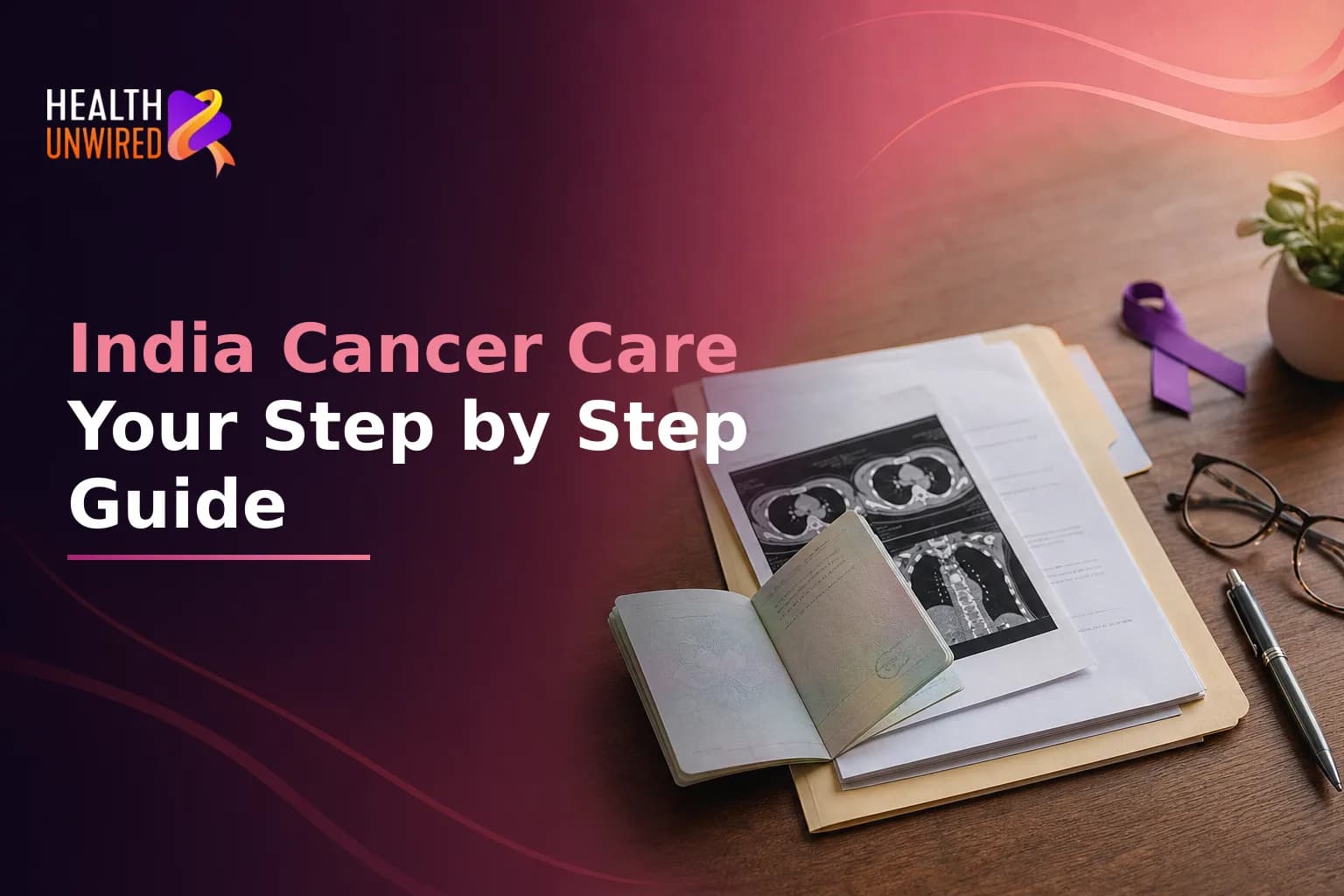
Planning cancer treatment in India as an international patient means organizing a medical visa, medical records, travel logistics, and a remote follow-up plan. This guide walks through every step so you can build a clear, practical timeline before you travel.
Updated on Jun 28, 2026
Medical Tourism to India for Cancer Care: A Step-by-Step Guide to Visas, Travel, and Remote Follow-Up
Planning cancer treatment in India as an international patient involves more steps than booking a flight and hotel. You need a valid medical visa, organized records, a confirmed hospital appointment, and a clear plan for follow-up care once you return home. This guide walks through each step so you can build a realistic timeline and avoid costly surprises along the way.
Eight Steps to Plan Cancer Treatment in India for International Patients
- Get a remote consultation to confirm whether India is the right fit for your case.
- Choose a hospital and request an official invitation letter from that facility.
- Apply for an Indian Medical Visa through the government's official e-Visa portal.
- Gather and organize your complete set of medical records.
- Book your flights and arrange accommodation near your treatment center.
- Register with the Foreigners Regional Registration Office (FRRO) within 14 days of arriving, if required by your visa type.
- Complete your treatment and collect all discharge documents and imaging files before you leave India.
- Set up a remote follow-up schedule with your care team before you fly home.
Why Do Patients from Around the World Choose India for Cancer Care?
India has built one of the world's largest oncology networks. The National Cancer Grid - a collaboration of more than 240 cancer centres - works to standardize treatment protocols across the country, as described by the National Cancer Institute. For patients from Nigeria, Kenya, Bangladesh, Nepal, the UAE, Myanmar, and many other countries, this network means access to multidisciplinary tumor boards, modern imaging, detailed pathology review, and advanced therapies - often at a single institution.
Cost is a central reason many families travel. Research indexed by the National Institutes of Health documents how the financial burden of cancer care creates real barriers for patients around the world. Many international patients find that treatment in India costs significantly less than comparable care in Western countries, though exact figures vary widely by cancer type, hospital, treatment plan, and length of stay. Always request a written, itemized cost estimate from the hospital before you commit to traveling - costs differ substantially between institutions and between cities.
In 2023, India approved its first domestically produced CAR-T cell therapy - a form of precision immunotherapy in which a patient's own immune cells are modified to recognize and attack cancer cells. The NCI reported in 2024 that this may give patients access to a treatment once available only at a handful of high-income centers, and at a fraction of global prices. Whether this therapy applies to your case is a question only your oncologist can answer - but it shows how India's cancer care options have expanded.
If your situation involves a specific cancer type, condition-focused guides can help you learn more. Patients researching prostate cancer care will find detailed information in our article on prostate cancer treatment in India: cost, expertise, and access for international patients. Those researching liver cancer can find a practical overview in our guide to liver cancer treatment in India for international patients.
Should You Get a Remote Consultation Before Booking a Flight?
Yes - and ideally, before you do anything else. A video consultation with a specialist oncologist lets you confirm your diagnosis and treatment plan are sound, understand whether traveling for care makes sense for your specific situation, and get a clear list of the records and tests you will need to bring. It also gives you an independent clinical view before you invest in flights and visas.
If you received your diagnosis recently, it helps to understand your pathology report and staging first. Our guide to the first 72 hours after a cancer diagnosis explains the key tests and documents you need to understand before making any major decision about where to get treated.
HealthUnwired connects patients with verified oncologists for video consultations. You upload your reports, choose a specialist, and receive a clinical review from home - no travel required. Many patients use this step to confirm they are a suitable candidate for treatment in India before committing to the logistics of travel.
How Do You Choose a Hospital and Get Your Invitation Letter?
India's major cancer centers are concentrated in cities including Mumbai, Delhi, Chennai, Hyderabad, and Bengaluru. When comparing hospitals, look for an accredited facility with an international patient services department, a named oncologist who will lead your care, and a patient coordinator who communicates in a language you understand. Transparent written pricing is also important - ask for a detailed quote in writing before you proceed.
Once the hospital has reviewed your records and agreed to treat you, they will issue a formal invitation letter - sometimes called an Appendix II letter. This document confirms your diagnosis, your proposed treatment plan, and the hospital's agreement to provide care. You cannot apply for an Indian Medical Visa without this letter, so request it as early as possible. Some hospitals issue it within a few days of reviewing your reports; others may take one to two weeks.
How to Apply for an Indian Medical Visa - Step by Step
India offers a Medical e-Visa specifically for international patients seeking treatment, and you apply for it entirely online. Processing does not require a visit to an embassy in most cases. Here is how the process works.
Gather your documents first
Before you open the online application, collect the following:
- A passport valid for at least six months from your planned arrival date, with at least two blank pages.
- Two recent passport-sized photographs with a white background, taken within the last three months.
- The official hospital invitation letter (Appendix II) on hospital letterhead.
- Your medical reports and imaging results.
- Proof of sufficient funds - recent bank statements or a financial guarantee letter from a sponsor.
- Proof of relationship for any family members who will travel with you as attendants.
Apply at the official government portal
Visit the Indian government's official e-Visa portal at indianvisaonline.gov.in and select Medical e-Visa as the visa type. Complete the online form, upload your documents, and pay the application fee. You will receive an email confirmation when your application is submitted. Be cautious of third-party websites that charge extra fees to fill in the same form - the official government portal is the correct and safest place to apply.
Wait for processing and approval
Processing typically takes 3 to 7 business days. You will be notified by email or SMS when a decision is made. Apply at least three to four weeks before your planned departure date to allow time for any delays or requests for additional documents.
Visa validity and extensions
The Medical Visa is initially valid for 60 days with triple entry. For longer treatment courses, it can be extended through the local FRRO office in India for up to six months. Your hospital's international patient department can guide you through the extension process.
Bringing family attendants
Up to two family members may travel with you under a Medical Attendant Visa. Their visa validity runs alongside yours. Each attendant will need to provide proof of their relationship to you, plus a copy of your visa, when they apply.
FRRO registration on arrival
Foreign nationals staying longer than 14 days on a Medical Visa need to register with the FRRO - the Foreigners Regional Registration Office - in the city where they are receiving treatment. Your hospital's international patient services team can walk you through this requirement and help you complete the registration.
What Medical Records Should You Bring to India?
A complete, well-organized set of records saves time and avoids delays at your first appointment. The American Cancer Society advises patients to keep thorough copies of all key documents - a habit that is especially important when seeking care internationally.
At a minimum, bring:
- Your pathology report, including any immunohistochemistry (IHC) results and molecular or genetic test findings. If you have original tissue samples - glass slides or a paraffin-embedded tissue block - ask the hospital in advance whether they need these for independent review.
- All imaging files: CT scans, MRI, PET-CT, and ultrasound. Bring both the written radiology report and the actual image files on a disc or USB drive.
- A clear summary of your treatment history - surgery notes, chemotherapy drug names (generic names where possible), radiation details, and treatment dates.
- Recent blood work and laboratory results.
- A current medication list with generic drug names and dosages.
- Any prior surgical or operative reports.
If your records are not in English, arrange translation before you travel. Many Indian hospitals can assist with translation on arrival, but having English-language documents in hand speeds up the clinical review. Keep both printed copies and digital copies stored in a secure cloud folder you can access from your phone or laptop during your stay.
What About Travel and Accommodation Near Your Treatment Center?
Most major cancer centers in India are located in large cities with well-connected international airports. Direct or single-connection flights are available from many cities across West Africa, East Africa, the GCC, Bangladesh, Nepal, Sri Lanka, the Maldives, and beyond. Your hospital's international department can often recommend flights and transfer arrangements that align with your appointment schedule - ask them early in the planning process.
Stay as close to the hospital as practical. Traveling long distances between accommodation and the hospital while undergoing treatment - especially during intensive chemotherapy cycles - is exhausting and risky if you need urgent attention. Many major Indian hospitals have on-site guest houses or partnerships with nearby hotels for international patients. Ask the international patient services team about accommodation options when you first make contact with the hospital.
India Standard Time (IST) operates as a single time zone across the entire country and does not observe daylight saving time. This makes it straightforward to schedule video calls with family back home or with your home-country doctor, without worrying about seasonal time changes.
How Do You Set Up Remote Follow-Up After Returning Home?
Remote follow-up - using video consultations and secure digital report sharing to stay in contact with your oncologist after you return home - is now part of modern cancer care. The NCI has noted that telehealth expanded significantly in cancer care in recent years, and the Institute's Telehealth Research Centers of Excellence (TRACE) are actively studying how to make remote cancer monitoring more effective and equitable for patients worldwide.
Before you leave India, have a specific conversation with your oncologist about your follow-up plan. Confirm the following before your discharge:
- Which follow-up blood tests and scans are needed, and whether you can have them done at a lab or imaging center near your home.
- How to share results securely with your India-based care team - by email, patient portal, or encrypted file transfer.
- The date of your first remote video call after returning home, ideally within four to six weeks of leaving India.
- Who to contact if you develop a new or urgent symptom between scheduled appointments.
- Whether your home-country doctor will receive a copy of your full discharge summary and treatment records, so both teams remain aligned.
Coordinating care across two countries is manageable when the handoff is planned in advance. Ask your India-based team to prepare a structured summary letter for your local physician - one that sets out exactly what treatment was delivered, what the follow-up schedule requires, and what warning signs to watch for.
To continue remote consultations with a verified oncologist after you return home, you can book a video consultation on HealthUnwired - upload your discharge documents, choose a specialist, and get a clinical review by video call, without any travel required.
When to Talk to Your Doctor
Talk to your oncologist before making any travel plans - especially if you are currently receiving treatment, have recently had surgery, or have active symptoms. Some cancer types and treatment phases may affect your fitness to fly, and your care team needs to assess this first. Raise the subject of remote follow-up early in your treatment course, before discharge, so you and your team are on the same page before you leave India.
This article is for general information and is not a substitute for medical advice. Always consult your oncologist or care team about your specific situation.
Frequently Asked Questions
Similar Topics
Kidney Cancer Treatment in India for UAE Patients
UAE patients with kidney cancer are increasingly choosing India for specialist oncology care, faster access t…
HealthUnwired Team
Sep 15, 2026
Lung Cancer Treatment in India for Pakistani Patients
Pakistani patients seeking specialist lung cancer care can access quality treatment in India at significantly…
HealthUnwired Team
Sep 11, 2026
Stomach Cancer Treatment in India for GCC Patients
GCC patients facing a stomach cancer diagnosis have realistic access to specialist care in India - shorter tr…
HealthUnwired Team
Sep 10, 2026