Prepare Your Lung Cancer Records for an Online Second Opinion
Knowing which documents to gather - from pathology slides to molecular test results to DICOM scan files - shapes the value of every second opinion you receive. This step-by-step guide walks you through every record you need and how to get it.
Updated on Sep 4, 2026
A second opinion is normal and healthy - not a vote of no confidence in your current doctor. When you have lung cancer, the records you bring shape everything. An online second opinion oncologist cannot examine you in person. What they can examine is your paperwork. The more complete your file, the more detailed and useful their review will be.
This guide explains which documents to gather, how to request them, and how to share them safely - so your time with a specialist focuses on your case, not on finding missing records. If you were recently diagnosed, your first steps after a lung cancer diagnosis provides more background before you prepare your records.
What records does an online oncologist need for a lung cancer second opinion?
Before you contact any specialist, know what a complete record set looks like. Here are the core documents, in order of priority:
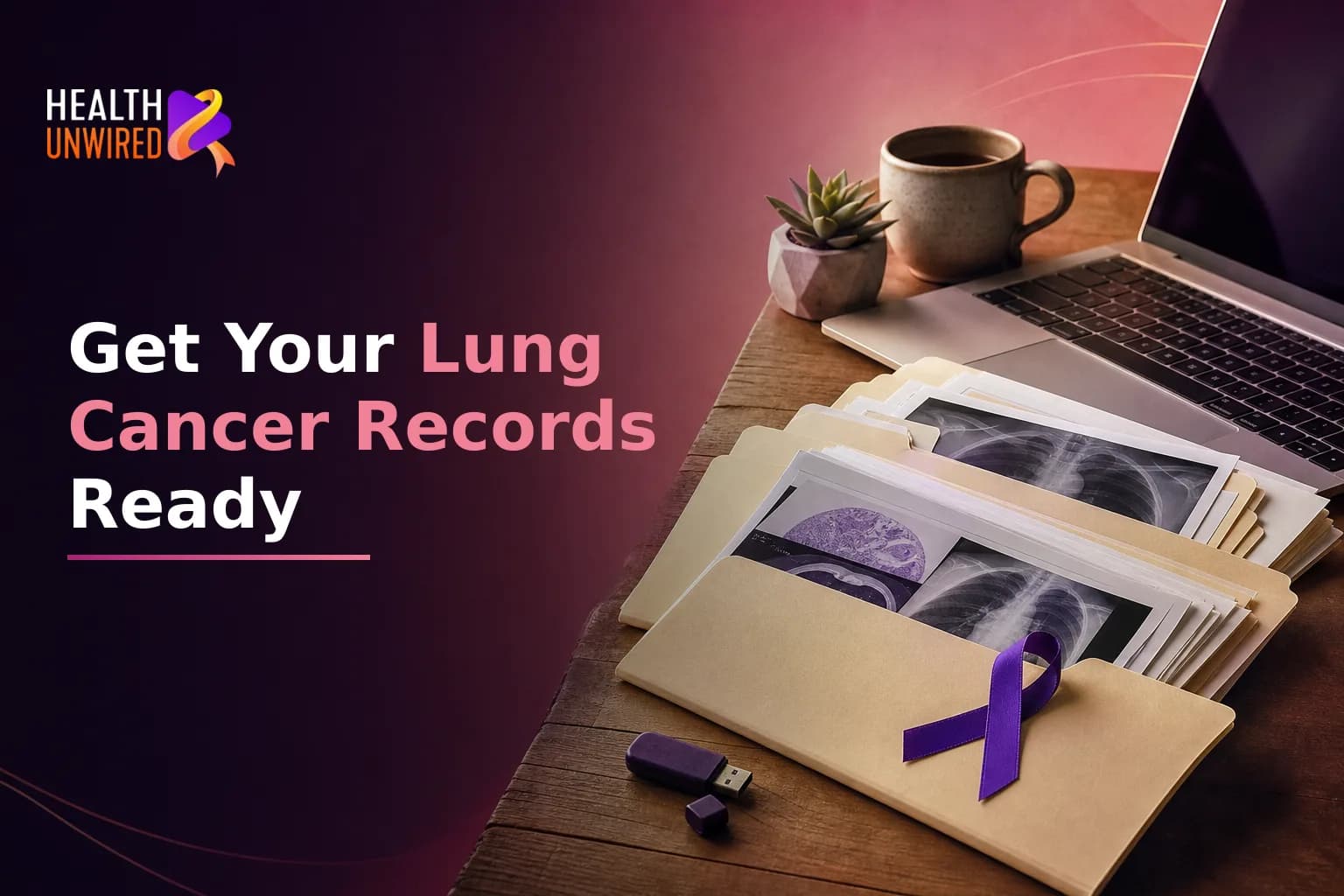
- Pathology report and tissue slides - the lab report from your biopsy or surgery, plus the physical or digital tissue slides
- Molecular and biomarker test results - results for EGFR, ALK, ROS1, PD-L1, KRAS, MET, and other markers tested on your tumor
- Imaging studies and radiology reports - CT scans, PET-CT scans, and MRI images in DICOM format, plus the written radiology reports
- Staging documentation - the TNM stage assigned to your cancer, usually in your oncologist's clinic notes
- Clinical notes from your oncologist - your diagnosis letter and follow-up visit summaries
- Treatment summary - if you have already started treatment, a list of what you received and how many cycles
- Recent lab results - blood counts and kidney and liver function panels from the last two or three months
You may not have everything on this list. That is fine. Gather what you have and note any gaps when you contact the specialist's office. Missing records rarely block a consultation - they simply limit how specific the review can be.
Why do pathology slides matter more than the written report?
According to the National Cancer Institute, a pathology report describes the cells in your biopsy or surgical sample and forms the foundation of your diagnosis. For lung cancer, the report tells the reviewing oncologist the cancer type (non-small cell or small cell) and the specific subtype, such as adenocarcinoma or squamous cell carcinoma, plus the tumor grade and whether cancer was found at tissue margins.
The written report alone is not enough. The second opinion oncologist also needs the tissue slides - thin slices of your tumor mounted on glass - or a high-resolution digital scan of those slides. The American Cancer Society explains that patients can request their slides and the paraffin-embedded tissue block from the pathology lab where the biopsy was processed. This is your right. The lab is expected to cooperate. Ask the pathology department directly. There is usually a small handling fee, and the turnaround is typically one to two weeks.
Some facilities offer digital pathology - a high-resolution image scan of the slides that can be shared as a file rather than shipped on glass. If your lab offers this, it cuts the wait from weeks to a few days and removes the risk of slides being lost or damaged in transit. Ask whether digital scanning is available when you call.
Why are molecular test results critical for lung cancer?
Lung cancer - particularly non-small cell lung cancer - is now one of the most tested cancers in oncology. Research on molecular testing of lung cancers published in the NIH-PMC archive shows that biomarker testing for EGFR, ALK, ROS1, PD-L1, and other markers is standard practice in managing non-small cell lung cancer. These results matter because the mutations in your tumor cells determine which targeted therapies or immunotherapy drugs may work for you.
A second opinion oncologist will look closely at whether comprehensive molecular testing was done, which panel was used, and whether the results make sense for your diagnosis and stage.
Your molecular testing report may include results for some or all of the following:
- EGFR mutation status
- ALK gene rearrangement
- ROS1 rearrangement
- PD-L1 expression level (reported as a percentage of tumor cells staining positive)
- KRAS mutation status (including G12C)
- MET amplification or MET exon 14 skipping mutation
- RET rearrangement
- BRAF mutation (V600E is most common)
- NTRK gene fusion, if tested
- Tumor mutational burden (TMB), if available
If your report covers only some of these markers, include it anyway. If you have not had molecular testing, that gap is important information - a second opinion specialist may recommend additional testing before any treatment decisions. For more on this topic, see our guide on whether you need a second opinion on molecular testing.
Do you need the actual scan files, or just the written radiology report?
Most patients receive a written radiology report - a text description of what the radiologist saw on the scans. That written summary is a useful starting point, but it does not replace the images. A specialist reviewing your case needs to look at the actual scans, not rely on another radiologist's description.
For lung cancer, you will likely need to share:
- CT scan of the chest - the full DICOM image files, not just a printed summary
- PET-CT scan images and report, if one was performed for staging
- Brain MRI images and report, if brain involvement was checked
- Any bone scans or abdominal and pelvic CT images taken for staging
DICOM is the standard digital format for medical images. Ask your hospital's radiology or medical records department for a CD, USB drive, or secure digital link with the DICOM files. Most departments can prepare this within a few business days. Ask for the full image set, not a summary disc with only a few slices.
If you are unsure which scans you have had, ask your oncologist's office for a list of all imaging, with dates and locations. That gives you a clear list of which departments to contact.
What clinical notes and staging documents should you include?
Your oncologist's clinical notes record what was discussed at each visit and what decisions were made. These give the reviewing specialist context that imaging and lab results alone cannot provide - the reasoning behind your treatment plan, the staging discussion, and any talk about treatment options.
Try to collect:
- Your cancer staging documentation - the TNM stage assigned to your cancer
- Clinic notes from your initial oncology visit and any follow-up visits
- A multidisciplinary team (MDT) or tumor board summary, if one was held for your case
- The surgeon's operative report, if you had lung surgery
- A treatment summary listing drugs received, number of cycles completed, and any dose adjustments - if treatment has already begun
A missing MDT summary or staging note should not stop you from booking a consultation. Share what you have. The reviewing oncologist will note what they want to see and advise you on next steps.
Which recent lab results should you gather?
Blood work tells the reviewing oncologist about your health and organ function. These results matter because treatment options often depend on how well your liver, kidneys, and bone marrow work.
Include the most recent two to three sets of results covering:
- Complete blood count (CBC) - red blood cells, white blood cells, and platelets
- Comprehensive metabolic panel (CMP) - liver enzymes and kidney function markers
- Any tumor marker tests your team ordered, such as CEA
These are usually the easiest records to get - often available right away through an online patient portal.
How do you request your medical records?
Requesting records from multiple departments takes time. A step-by-step approach helps:
- Start with your patient portal. Many hospitals and oncology offices let you download visit notes, lab results, and some imaging reports. Check what is available before calling.
- Call your oncologist's office. Ask for copies of clinic notes, your staging summary, and any reports in your chart. Most offices have a records team that handles these requests regularly.
- Contact the pathology lab separately. Slides and tissue blocks are stored by the lab that processed your biopsy, which may not be your oncologist's office or hospital. Call that lab directly and ask for slides, the paraffin block, the pathology report, and whether digital scanning is available.
- Contact the radiology department for DICOM files. Imaging is managed by a radiology department. Request the full digital image files, not just a printed or PDF report.
- Keep copies of everything for yourself. The American Cancer Society recommends keeping your own copies of all medical records.
Contact all departments at the same time. Pathology and imaging requests can run together, which saves time. If you are requesting records from another country or a system in a different language, ask the consultation platform whether they have a patient coordinator to help you before your appointment.
How do you share records for an online consultation?
Once your records are gathered, uploading them is simple. Most telehealth oncology platforms accept:
- PDF files for reports, letters, clinical notes, and lab results
- DICOM files for imaging studies, often uploaded via a secure link or cloud folder the platform provides
- JPEG or PNG scans of paper documents photographed clearly with a smartphone camera
Use the platform's secure upload portal instead of email for anything with personal health information. Label your files clearly by document type and date - for example, "CT-chest-report-March2026.pdf" or "EGFR-molecular-result-Jan2026.pdf" - so the specialist can find what they need. You do not need a perfect binder. Clear, labeled files are enough.
To see what happens once a specialist receives your records, see what to expect during your 60-minute telehealth oncology consultation.
What happens after the specialist reviews your records?
Once the review is done, you will have a video call to discuss the findings. Memorial Sloan Kettering Cancer Center notes that a second opinion may confirm your current diagnosis and plan, show a different way to interpret the findings, flag additional testing that could change the approach, or point out clinical trials that fit your cancer profile.
The goal is not to criticize your current oncologist. It is to give you a complete picture before you make a big decision. The better your records, the better the review will be - which is why gathering them carefully matters.
To book an online second opinion - upload your records, pick a verified oncologist, and have a video call within 48 hours from home with no travel - visit HealthUnwired's online consultation page.
When to talk to your doctor
Talk to your oncologist or care team before your second opinion appointment if you are unsure which tests you have had, if treatment is about to start and you want to know if a brief pause is safe while you gather records, or if your files are in multiple hospitals and you need help on where to start. Your current doctor should support your right to seek a second opinion. If you are unsure how to bring it up, lung cancer treatment options and when to get a second opinion covers how to approach it.
This article is for general information and is not a substitute for medical advice. Always consult your oncologist or care team about your specific situation.
Read the full guide
Similar Topics

Lung Cancer Treatment in India for Pakistani Patients
Pakistani patients seeking specialist lung cancer care can access quality treatment in India at significantly…
HealthUnwired Team
Sep 11, 2026

Lung Cancer Treatment in India for West African Patients
West African patients with lung cancer increasingly travel to India for comprehensive molecular testing, spec…
HealthUnwired Team
Aug 21, 2026
Newly Diagnosed with Lung Cancer: Your First Steps
A lung cancer diagnosis comes with an avalanche of tests, medical terms, and urgent decisions. Here is what t…
HealthUnwired Team
Aug 10, 2026