Your 60-Minute Telehealth Oncology Consultation
Booked a telehealth oncology consultation and not sure what to expect? This minute-by-minute guide walks you through every phase of a 60-minute video visit with a specialist oncologist.
Updated on Aug 6, 2026
Your 60-Minute Telehealth Oncology Consultation
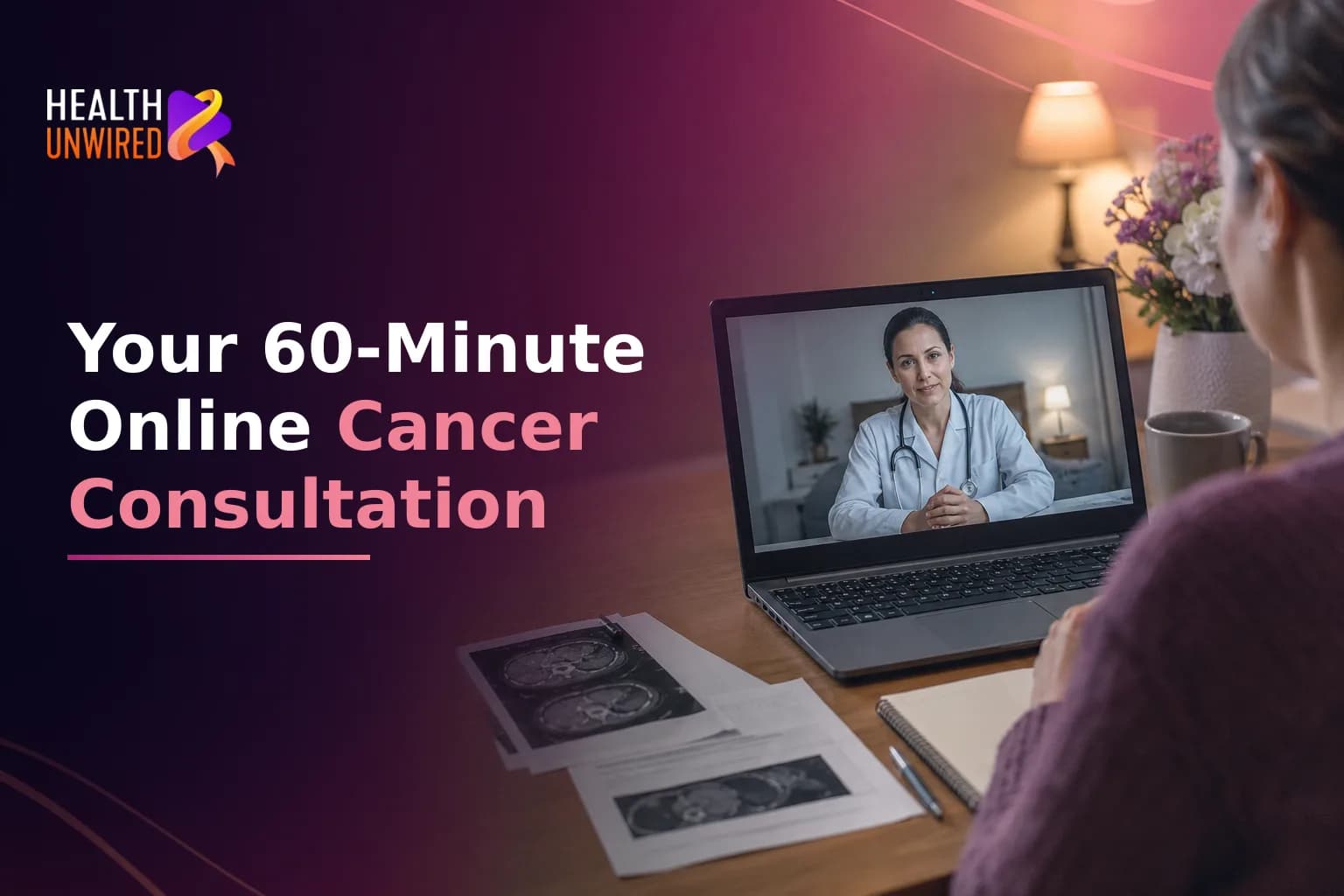
You have booked a telehealth oncology consultation. In the next hour, a specialist will review your records, ask questions, and give you their expert opinion on your diagnosis or treatment plan. You may feel both relief and nerves before the call. Not knowing what to expect often causes the nerves. This guide explains what to expect. Below is a minute-by-minute breakdown so you can prepare for your visit.
The American Cancer Society describes telemedicine as a video visit with your provider through a secure platform - giving you access to specialist expertise without travel. The American Society of Clinical Oncology has published oncology-specific telehealth standards to guide how these visits work, covering everything from patient preparation to record security.
At a Glance: The 60-Minute Breakdown
- Minutes 0-5: Tech check and identity confirmation. Your uploaded records are verified.
- Minutes 5-15: The oncologist reviews your diagnosis, cancer type, current stage, and medical history.
- Minutes 15-30: Review of your pathology report, imaging scans, and recent lab results.
- Minutes 30-45: The specialist presents treatment options and explains the reasoning behind each.
- Minutes 45-55: Your questions - this time is for you and your caregiver.
- Minutes 55-60: Summary, written report timeline, and next steps.
Before the Call: What to Have Ready
A telehealth oncology consultation works best when the specialist has your full picture before the call starts. Most platforms ask you to upload records at least 48 hours in advance. Here is what you need to prepare:
- Pathology reports - the written description of your biopsy or surgical specimen
- Radiology reports - for any CT, MRI, PET-CT, or bone scan results
- Imaging files, ideally in DICOM format (the standard digital file format for medical scans)
- Recent blood work and any tumor-marker results
- A current list of all medications, including supplements
- A brief written summary of treatments received so far - with dates and drug names where you have them
For a detailed walkthrough on preparing your home setup and documentation, see How to Set Up Your Home for an Online Oncology Consultation. It covers the tech check and the records checklist in one place.
Minutes 0-5: Tech Check and Confirmation
The first few minutes are administrative. A coordinator or the oncologist's assistant will confirm your name, date of birth, and that your records have been received and are accessible. They will run a quick audio and video check.
If anything goes wrong technically - a frozen screen, no audio - say so right away. Most platforms have a phone backup option, and many consultations can continue by voice if the video connection drops. Log in two or three minutes early so this does not take away from your clinical time.
Minutes 5-15: Your History, Diagnosis, and Stage
Once the oncologist is on screen, they will introduce themselves and describe how they prepared for your case. They have already read your records. This is not a cold review - it is a focused talk that picks up from where you are now.
You should expect questions like:
- When and how were you first diagnosed?
- What symptoms, if any, brought you to a doctor?
- What treatments have you already received or been offered?
- Are you currently experiencing any side effects or new symptoms?
- What has your local oncologist recommended, and what do you think about that plan?
Be direct and specific. If you are not sure about a detail - a drug name, a dose, a date - say so rather than guessing. Being accurate matters more than knowing everything at this stage.
Minutes 15-30: Deep Review of Your Records and Scans
This is the technical core of the visit. The oncologist works through your pathology report, imaging, and blood results. They may share their screen to show you a specific finding, or they may explain the key points in plain language as they review.
For a lung cancer second opinion, for example, the specialist will check tumor type, grade, and whether molecular or biomarker testing has been done. For any cancer type, they will look at whether the staging workup - the scans and tests used to determine how far the disease has or has not spread - was thorough enough to support the current recommended plan.
If there are gaps in your records - a missing scan, a biomarker test not yet ordered, imaging that is out of date - a thorough specialist will point them out. Knowing what is still missing is part of the value of this review.
A systematic review on patient-driven second opinions in oncology found that changes in diagnosis, treatment recommendations, or prognosis happened in 12 to 69 percent of second-opinion reviews across cancer types. The wide range shows how much variation exists by cancer type and by how complete the submitted records are.
Minutes 30-45: Treatment Options and Second-Opinion Findings
This is where the specialist shares their independent clinical view. They will either confirm that the proposed plan matches current guidelines for your cancer type, or they will explain an alternative approach and the reasoning behind it. Both outcomes are useful.
During this part of the consultation, you may hear about:
- Whether the recommended surgery, radiation, or systemic therapy matches current evidence-based guidelines
- Whether additional testing - such as molecular profiling or genomic sequencing - could help with the treatment choice
- Whether clinical trials are open that might be relevant to your case
- Whether the sequence of treatments - for example, systemic therapy before versus after surgery - is best for your situation
The specialist will not make decisions for you. They give you information - their professional reading of your case - so that you and your treating oncologist can make a more informed choice together. If the second opinion differs from the current plan, that does not mean one doctor is wrong. It means you have more to work with. The article What Changes After a Second Opinion in Cancer Care explains how to use that difference constructively.
Minutes 45-55: Your Questions
This time belongs to your questions. Write them down before the call and list them in order of what matters most. Stress can make you forget what you wanted to ask most.
Questions worth bringing:
- Is there any test that has not been done yet that could change the recommendation?
- If I follow this plan, what are the most common short-term and longer-term effects?
- Are there specialist centers that see high volumes of my cancer type and that I should consider for treatment?
- Is there a clinical trial I might qualify for?
- What is the single most important thing I should do after this call?
It's also OK to ask about cost, timing, travel, and how treatment might affect your daily life. A second-opinion oncologist gives you both the clinical and practical picture.
Minutes 55-60: Wrap-Up and Next Steps
The final minutes are for summary. The oncologist will outline their key findings and confirm what they are recommending. They will tell you when to expect the written report - usually within two to five business days - and what it will contain.
Before you sign off, ask: "What is the one thing I should do first after this call?" That question tends to cut through complexity and give you a clear immediate action rather than a long list of possibilities.
If the specialist suggests a further test, a referral, or additional records they need to see, note it. Confirm how to send anything extra through the same secure platform.
What a Video Consultation Cannot Replace
A telehealth oncology consultation is a high-quality clinical review. It is not a substitute for a physical examination. Sometimes a doctor needs to examine something in person, feel an area by hand, or do a procedure face-to-face. If the specialist concludes that an in-person visit is also needed, they will tell you and explain why.
For most second opinions - reviewing a treatment plan, checking staging, or finding a different approach - video works well. The National Cancer Institute has shown that telehealth in cancer care is growing and that video works well for many types of consultations.
Should Your Caregiver Be on the Call?
Yes, in most cases. A caregiver or family member can take notes while you listen, ask questions you might miss, and help you remember what was said. Tell the specialist who else is on the call. This is normal.
For a fuller guide on how to involve a caregiver effectively - including which moments in the call benefit most from their input - see Should Your Caregiver Join Your Online Oncology Consultation?
When to Talk to Your Doctor
If anything covered in your telehealth consultation raises a question about a new symptom, a drug interaction, or how quickly you need to act on a recommendation, bring it to your treating oncologist or care team directly. A second opinion is a tool for better decision-making - your primary care team remains the right place to act on what you learn.
If you're ready for a consultation, you can upload your records and get a video consultation with an oncologist within 48 hours - no travel needed, no waiting rooms, from anywhere in the world.
This article is for general information and is not a substitute for medical advice. Always consult your oncologist or care team about your specific situation.
Similar Topics
Leukemia Second Opinion: What Hematologic Oncologists Review
A leukemia second opinion is a recognized and normal step in blood cancer care. This guide explains exactly w…
HealthUnwired Team
Sep 18, 2026
Understanding Your Lymphoma Diagnosis and Staging
A lymphoma diagnosis involves three steps: a biopsy, a pathology report naming your exact subtype, and a stag…
HealthUnwired Team
Sep 16, 2026
Newly Diagnosed with Leukemia: Your First Steps
A leukemia diagnosis is overwhelming, but your first moves can shape everything that follows. Here is what to…
HealthUnwired Team
Sep 14, 2026